
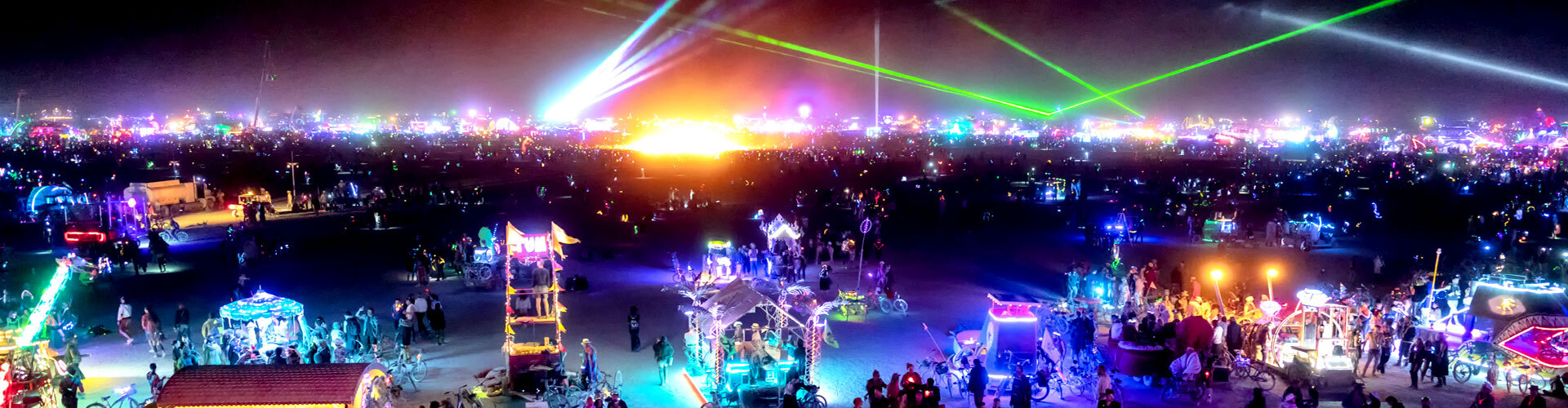
If the period between 1986 and 1990 represents for Burning Man an infancy and childhood enjoyed in a great sandbox on the beach in San Francisco, then the early years of Black Rock City in Nevada equate to a kind of gangly adolescence. This era climaxed in 1996 as a crisis that was like a bout of teenaged angst. In the following year, 1997, Burning Man produced a newly-ordered city. This signaled the commencement of a kind of college education. Six intervening years have passed, and Black Rock City has matured. It has acquired depth of character, a new self-awareness. As the physical infrastructure of Black Rock City has grown ever more elaborate, the societal infrastructure of our community has also developed. Over the years, our participants have become citizens, and, in doing so, they have internalized an ethos. That ethos now extends beyond the lessons both they and we learned in this most curious of schools.
In 2003, the organization of the Burning Man Project certainly showed signs of a new maturity. As one specific example of change, instead of simply hiring friends to fill positions of responsibility, we began to advertise throughout our community to meet arising needs for new kinds of management. This change, of course, made us more business-like. Instead of matching people to more or less ill-defined roles, we learned to very carefully define these roles then seek out people who were both ready and qualified to perform them. But, more importantly, this new practice is also evidence of a much broader base of participation. In soliciting new help in 2003, we received responses from Colorado, New England, even Australia.
Furthermore, this greater community is also beginning to organize itself. In recent years, regional events have sprung up, from New Zealand to Australia, from Hawaii to New York, and some have grown, like our own event, into increasingly large assemblies. It is now possible, in fact, to tour America following an itinerary that will guide the enterprising traveler continuously from one gathering to another. Our culture is growing out into the world, and throughout 2003 the Burning Man Project worked to help this happen. One of our most significant achievements in 2003 has been the newly launched Burning Man Network. Volunteer Regional Contacts, representing communities throughout the United States and in other countries, are now joining us in this movement, and we’ll premier what we are now creating in June 2004.
The significance of Burning Man also dawned upon the art world in 2003. Several art journals published accounts of the event. Beyond the mainstream, beyond the art market, beyond the pavement of established institutions, weve invented a new genre of interactive art that is beginning to intrigue the world. In addition to the thousands, if not millions, of creative acts at the event in 2003, and in addition to hundreds of formal art works created by participants, the Burning Man Project also began to reconsider an art production of its own. The platform of the Burning Man (which last year, in accordance with our theme, Beyond Belief, was called a temple) became a much more interactive artwork. Styled as a Pre-Columbian pyramid, it housed shrines at its base that were continually occupied by participants, self-sanctified by its environment. In 2004, our theme, entitled Vault of Heaven , will take this interactive inclination a decisive step further. Our goal is to create a special space, a teeming pavilion that will engender more meaningful encounters per square-foot than any work of art has yet achieved. It is our hope to inspire many other Burning Man communities to create innovative environments of their own.
Burning Man, in fact, is increasingly taking on a double mission: In one way, it models what the world could be, and in another it embodies dedication to changing what the world is. This is, to say the very least, an intensely challenging vision. This challenge is why we have become so organized. It is why we actually bring passion to our budget meetings. It is why we are gradually employing more people to help us, and why we are carefully counting our pennies each year. We are creating a tool, a means to an ambitious end, a means, in fact, that is in many ways indistinguishable from its end: Were creating more meaning and culture. For anyone who doubts this bold assertion, we suggest you skip forward and read about our Future Vision. Like many of the sections in this AfterBurn Report, it tries to explain where we are, how we managed to get here, and where we think we are going.
Submitted by,
Larry Harvey