
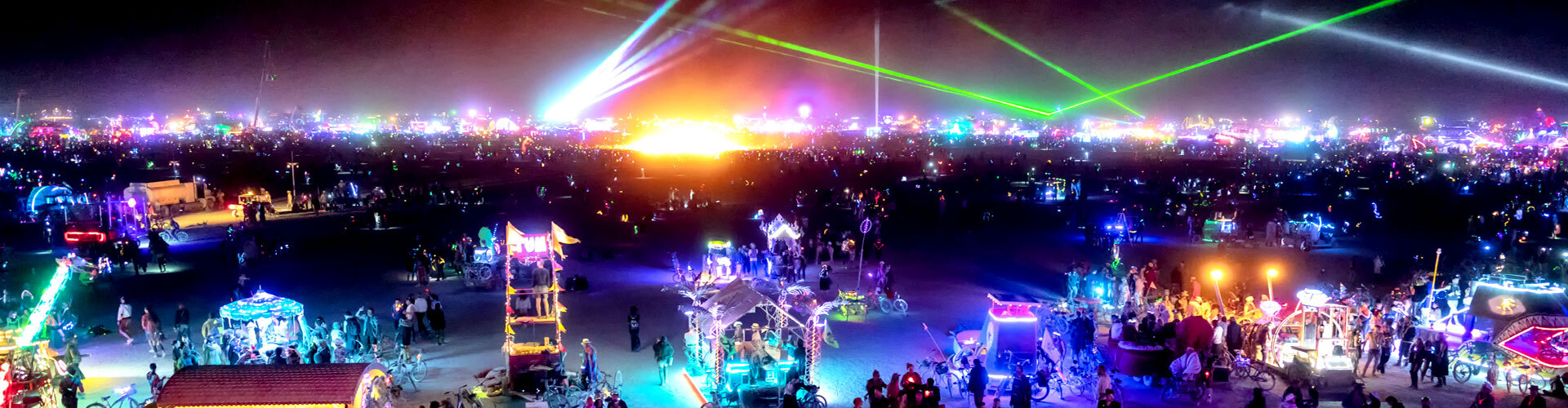
For the last two years we have held a Town Meeting in the December after Burning Man. These have taken place in San Francisco. About 200 to 300 people attended last year’s meeting, and some of them came from outside the Bay Area. It was held at CELLspace, a local community arts facility that could not have accommodated many more people. We still intend to hold a spring meeting in 2002, but this winter, we’ve decided to break out of the box. Our Winter Town Hall meetings lasted only 3 to 4 hours, scarcely enough time to answer everyone’s questions. And it certainly wasn’t enough time for us to describe everything we had done during the year. Instead, we’ve elected to write a year-end report that is addressed to every Burning Man participant wherever they may reside. A web-based document such as The AfterBurn Report can be visited by many more people. We hope this will supply a context for the questions that follow.
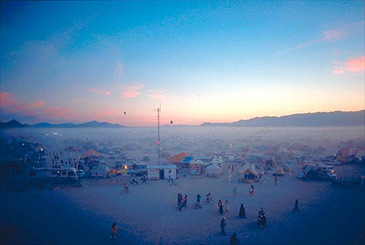 This is a big departure for us. During the many years that all of us have worked on Burning Man, we have concentrated most of our attention on describing the experience of our event, but the organization of people behind this event has remained something of a mystery. This is mainly because we’ve always been too busy doing Burning Man, continually reorganizing and planning for the next year to illustrate the architecture. But now we feel it is time to turn about and introduce our organization to participants. The Burning Man Project includes the small group of our full-time staff, a much larger group of part-time staff and the many hundreds, indeed, thousands, of volunteers whose responsibility and dedication make Burning Man happen. This report will explain what our various departments do, why they do it, what changes have been made in 2001, where Burning Man’s money goes, our successes and failures, and our vision for the future.
We currently divide the Project into several departments, and members from each of these departments have written this report. We intend for the reader to see how all of these interdependent groups work together to produce a city in the desert and a community that lasts year-round. This includes the work of Burning Man’s Senior Staff, and our administration department in San Francisco that runs our business office, our accounting and our box office and ticket process. It describes the many tasks confronted by our art department, which places art in the desert, develops our annual art theme, aids many artists with their work, maintains our archive and sponsors the Fire Conclave. It details the functions of our media department and its responsibility for public relations and media relations, print production, the Black Rock Gazette, regional groups, our computer technology and systems administration our website, and several other endeavors. We explain our services, such as the organization of our Café, our ice concession, and workers commissary, and we describe how our community service department works in support of our Lamplighters, Earth Guardians, Greeters, Playa Information, recycling, theme camps and their placement our bus service and Burning Man Information Radio. This outline will also portray our two largest volunteer-departments, the department of public works known as the DPW and the Black Rock Rangers. It will describe in detail how our department of public works creates our city’s infrastructure and has developed and maintained our operations base at our work ranch in the desert, and it will explain how the Rangers operate our gate, provide emergency services, volunteer Ranger training, DMV, and Event exodus, and interface with county, state and federal law enforcement.
Burning Man in 2001 was, in many ways, a very significant year for us. We worked harder to provide more training and share more information resources within our organization. We developed new technologies and utilized the skills of more volunteers than many organizations can even dream of, and we worked with local law enforcement, exchanging information and philosophies in order to protect our citizen’s rights. We feel the net result of all this effort was a much better experience for participants and ourselves. We were truly ready when our gates opened (perhaps, for the first time!). During the event, our portable toilets (long a scandal among participants) remained clean, and, when everyone departed, exodus was smooth and we had to clean up far fewer burn scars and trash. From our own unique and personal perspective, however, the best result of all was that our organization, as intricate and complex as it may seem, came together as a real community united in a single spirit. People say that Black Rock City is their home. Ironically, for many of us who work year-round to create that city, we spend much of our time at the event working there also. For us, our true home has become one another and the work that we do together. Now we would like to invite you into it. Welcome to our home.